
Search Randolph County Court Records
Randolph County court records are searched first through the North Carolina eCourts Portal. The public Portal is free for ordinary public searches and supports Smart Search, hearing searches, judgment searches, and online payments where a case or citation is eligible. Randolph County joined the eCourts system in the 2024 Track 6 rollout, so older local instructions that point to pre-eCourts tools may be out of date.
Smart Search is the main court case lookup. It accepts a party name, case number, citation number, attorney name, attorney bar number, business name, cross-reference, or nickname. The official case number format uses a two-digit year, case-type letters, a six-digit sequence, and a county code, such as 21CR000003-910. If the online record is incomplete, the fallback is the Clerk of Superior Court office or a public terminal.
- Open the North Carolina eCourts Portal and choose Smart Search for case information.
- Enter a party name, case number, citation number, attorney name, business name, or other known identifier.
- Use advanced filters for Randolph County, case type, case status, date of birth, or filing date range.
- Review the case summary, events, hearings, dispositions, and financial entries that are public.
- Contact the Randolph County Clerk of Superior Court for certified copies, background checks, paper files, or records that need in-person review.
The NC Judicial Branch Randolph County landing page is part of the home-page image set.
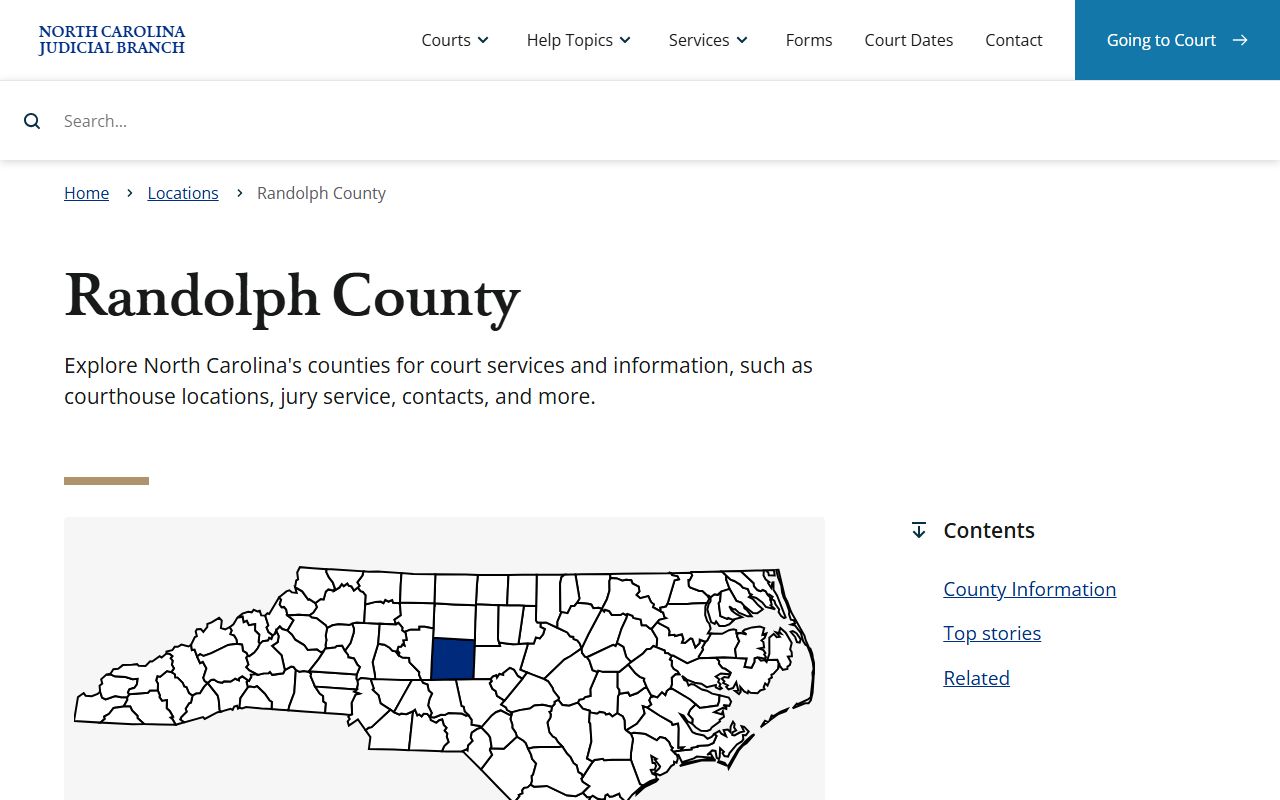
That county landing page connects court dates, services, payments, local rules, and courthouse information in one official place.
Randolph County Courthouse
Randolph County court functions are centered at the Randolph County Courthouse in downtown Asheboro. The Clerk of Superior Court works from Suite 201 and is the main office for court case files, copies, costs, estates, divorce judgments, special proceedings, and criminal records. The courthouse is a state court location, even though county pages also publish local building information and visitor rules.
A key visitor rule is the courthouse device ban. Randolph County says cell phones, computers, multimedia devices, and cameras are not allowed in the courthouse. Juror parking is separate from the large public parking lot, and ADA help starts with the Bailiff's Information Desk. The Register of Deeds is nearby in the Shaw Building, but it is not the court clerk.
Randolph County Courthouse
176 East Salisbury Street
Asheboro, NC 27203
(336) 328-3000
Public hours: 8:00 a.m. to 5:00 p.m., Monday through Friday
Clerk of Superior Court
176 East Salisbury Street, Suite 201
Asheboro, NC 27203
(336) 328-3100
Office hours: 8:30 a.m. to 5:00 p.m., Monday through Friday
Register of Deeds
158 Worth Street
Asheboro, NC 27203
(336) 318-6960
Marriage and vital records are handled here, not at the court counter.
The county courthouse source also appears in the image manifest for the home page.
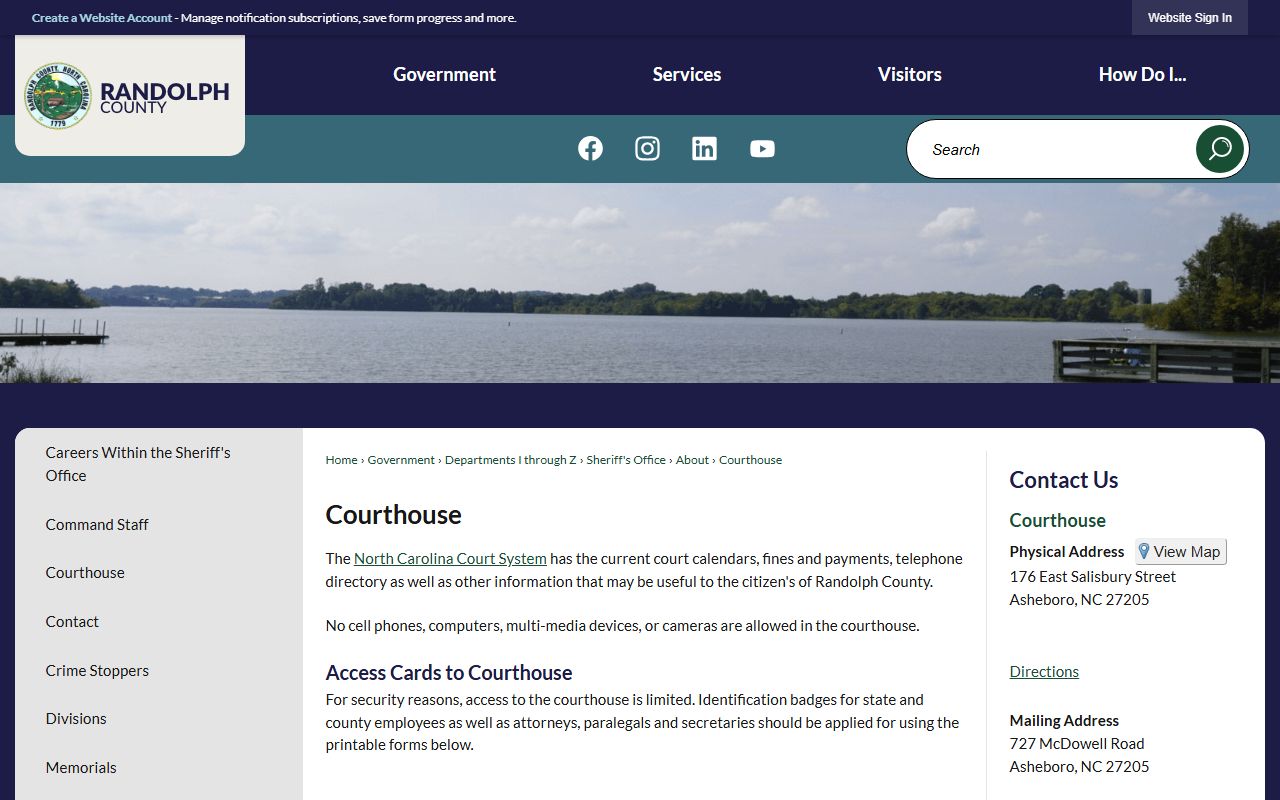
That county page is useful for practical courthouse rules, including the device restriction that affects records visitors.
The official Judicial Branch courthouse profile is also assigned to the home page.
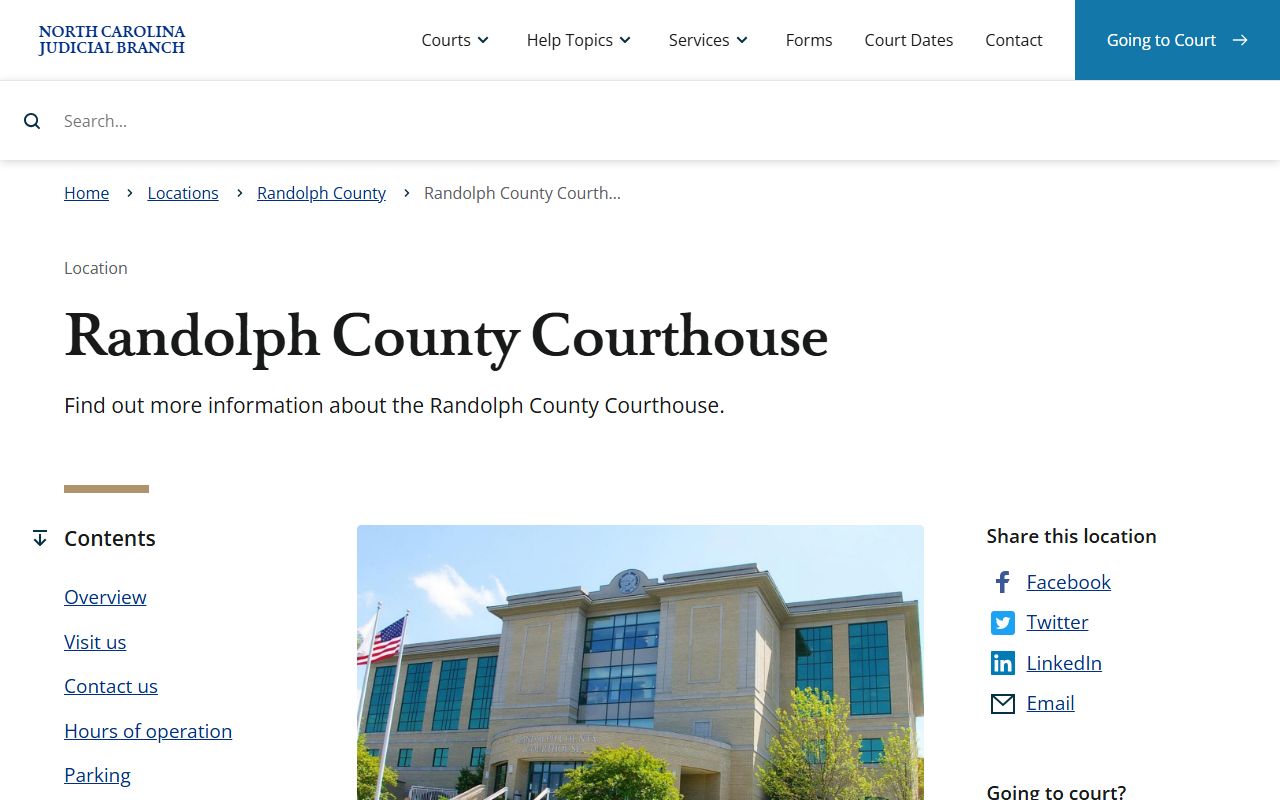
That profile is the stronger source for courthouse address, hours, parking, ADA contacts, and building-level court information.
The official court contact directory rounds out the courthouse access picture.
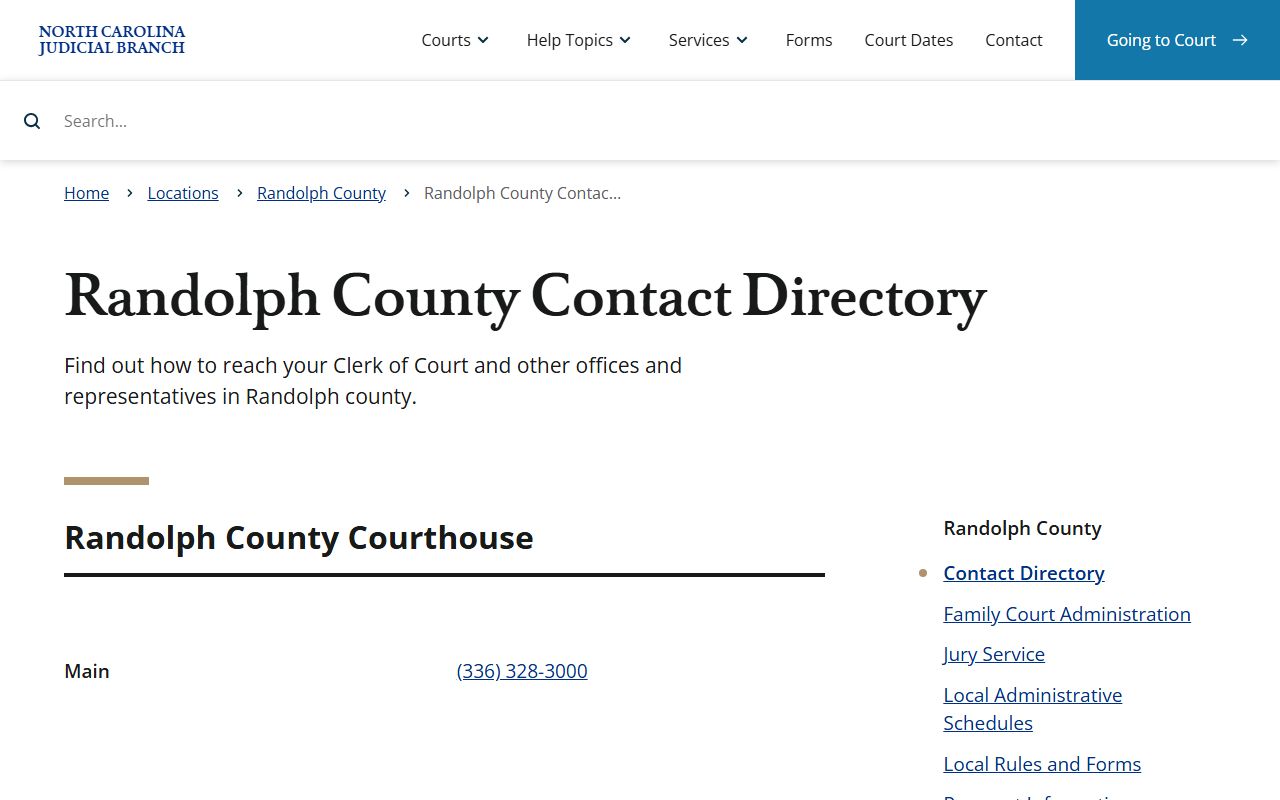
The contact directory is where clerk, magistrate, judge, district attorney, jury, mediation, and family-court phone numbers are organized.
Randolph County Court System
North Carolina uses a unified state Judicial Branch. Randolph County is listed as Prosecutorial District 37, Superior Court District 37, and District Court District 37. The Superior Court is the general jurisdiction trial court for felonies, larger civil cases, and appeals from District Court misdemeanor and infraction matters. District Court handles misdemeanors, traffic infractions, many civil matters, small claims appeals, juvenile matters, and domestic cases.
Case flow: Magistrate or District Court › Superior Court › Court of Appeals › Supreme Court of North Carolina.
| Court or Office | Role in Randolph County | Common Record Types |
|---|---|---|
| Superior Court | General jurisdiction trial division | Felonies, larger civil cases, appeals from District Court |
| District Court | Limited jurisdiction trial division | Misdemeanors, traffic, domestic, juvenile, small claims appeals |
| Magistrates | Judicial officers for initial process and small claims functions | Warrants, first appearances, bond issues, some civil ceremonies |
| Clerk of Superior Court | Court clerk and probate judge for many estate matters | Court files, estates, special proceedings, copies, costs |
The North Carolina court structure overview is one of the official sources captured for Randolph County.
The statewide structure is important because Randolph County does not run a separate county court system outside the Judicial Branch.
Randolph County Court Record Types
Public court records in Randolph County can include criminal, civil, family, probate, traffic, special proceeding, and warrant-related criminal process records. Each type has a different custodian and access limit. Court case files and divorce judgments go through the Clerk of Superior Court. Marriage licenses and marriage certificates go through the Register of Deeds. Current jail status goes through the Sheriff's Office.
- Criminal court records: charges, pleas, hearings, dispositions, sentencing, fines, costs, probation entries, and case events when public.
- Civil court records: complaints, answers, motions, orders, judgments, service details, hearings, and financial entries.
- Family and divorce records: divorce judgments, custody, support, equitable distribution, domestic violence, alimony, and related filings, with privacy limits.
- Estates and special proceedings: wills, letters, inventories, guardianships, partitions, orders, and clerk proceedings where public.
- Traffic court records: citations, waivers, court dates, fines, costs, dispositions, and license-related consequences.
The official types of courts source was captured for the Randolph County build.
That source helps separate Superior Court, District Court, appellate courts, and special state court functions.
What Randolph County Court Records Show
Randolph County court records should be read with North Carolina eCourts terms in mind. A Smart Search case summary can show the register of actions, case information, assignment information, parties, causes of action, events, hearings, dispositions, documents, and financial information. Public access depends on the case type, redactions, and whether the user has elevated access.
| Field | What It Shows |
|---|---|
| Case number | Enterprise Justice number with year, case type, sequence, and county identifier. |
| Case information | Case type, status, filing date, location, and public case-level details. |
| Party information | Plaintiff, defendant, petitioner, respondent, decedent, attorneys, or other roles when public. |
| Events and hearings | Motions, filings, orders, hearing dates, courtrooms, judicial officers, and event types. |
| Disposition | Outcome of a charge or case, such as judgment, dismissal, plea, or other result. |
| Financial entries | Costs, fines, restitution, attorney fees, probation fees, or payment status where applicable. |
- Docket
- A chronological list of filings, hearings, and court actions.
- Disposition
- The outcome of a charge or case.
- Expunction
- A legal process that clears eligible records from public record.
- Elevated access
- Portal access for users with legal authority to see restricted material.
Randolph County Public Access Rules
Randolph County court access comes from state law and Judicial Branch policy. The general public-record framework is North Carolina's Public Records Act, while court indexes and case access are also tied to Judicial Branch rules and statutes. Returned arrest warrants, returned search warrants, indictments, criminal summonses, and nontestimonial identification orders are public records unless sealed by court order.
Key Statutes:
N.C. Gen. Stat. Chapter 132 provides the general public-record framework for North Carolina agencies.
Chapter 132 criminal process provisions treat returned warrants and related process as public unless sealed.
N.C. Gen. Stat. 7A-109(b), referenced in Portal guidance, supports public inspection of certain court records and indexes.
N.C. Gen. Stat. 15A-153 explains the effect of an expunction on public records.
For criminal background-check use, the Judicial Branch points users to the county clerk's office instead of relying on Portal alone. For restricted records, elevated access is limited to users with legal authority.
Restricted Randolph County Court Records
Some Randolph County court records do not appear in public search results. Juvenile records are not ordinary public case files. Sealed records are withheld by law or court order. Expunged records are cleared from public record if the court grants the petition. Mental health proceedings and protected personal identifiers are also restricted in public Portal access.
An expunction is not automatic just because a case is old or dismissed. Eligibility can depend on the offense, disposition, prior record, waiting period, and statutory exclusions. North Carolina law excludes some offenses, including impaired driving, from certain expunction paths. Case-specific questions belong with the Clerk of Superior Court or a lawyer.
Note: Public Portal access may omit documents that exist in a paper file or require elevated authority.
Randolph County Sheriff and Jail
The Randolph County Sheriff's Office is at 727 McDowell Road in Asheboro. Sheriff Gregory J. Seabolt is listed on the official Sheriff's Office page. The office publishes law enforcement contacts, records contacts, civil division contacts, and jail contacts. For current custody status, Randolph County uses a confined inmate page with current inmate lists sorted by date confined and last name.
The jail roster is public information, but it is not a criminal history or court outcome. The list updates automatically four times daily and may show booking and bail information. Once a person leaves county custody for state prison, probation, or parole, the North Carolina Department of Adult Correction offender search is the statewide fallback. The free RCSO App also packages current inmates, most wanted, tips, sex offender research, alerts, BOLOs, news, events, and social media in one mobile tool.
The sheriff source connects court-related records work to jail status, warrant channels, and public safety contacts.
Randolph County Warrant Records
Randolph County does not publish a standalone official active warrant search page in the research sources. The official warrant access chain is the Sheriff's Office, the Clerk of Superior Court, magistrate contacts, eCourts case records, the confined inmate roster after arrest, returned warrant records under North Carolina law, and the RCSO App for most wanted and tips.
Returned arrest warrants and returned search warrants are public unless sealed. A bench warrant or order for arrest may appear through a related criminal case, failure-to-appear event, bond issue, or court date. Safety-sensitive matters should be handled by calling the Sheriff's Office, a lawyer, or the clerk rather than using third-party warrant sites.
Randolph County Marriage Divorce Probate
Marriage licenses and marriage certificates are Register of Deeds records. Divorce judgments are court records through the Clerk of Superior Court in the county where the divorce was granted. North Carolina Vital Records also has divorce certificates from 1958 to the present. Probate and estate matters in Randolph County are handled by the Clerk of Superior Court acting as ex officio judge of probate.
Marriage applicants complete the online application before visiting the Register of Deeds, appear with required ID and Social Security proof, and pay the marriage license fee. Probate users normally start in the county where the decedent lived, bring the original will if one exists, and use statewide Judicial Branch estate forms.
That distinction keeps users from going to the court clerk for marriage records that belong at the Shaw Building.
Randolph County Traffic Court Records
Randolph County traffic cases run through the North Carolina state court system, mainly District Court, with lookup and payment through the eCourts Portal and the Clerk of Superior Court. A traffic court record is not the same as a state driver record. The court record shows citation, charge, court date, disposition, fines, costs, payment status, and hearing events. The driver record is held by state driver-record channels and shows license status, reported convictions, suspensions, and points history.
People who choose to pay a citation online must still meet the deadline or appear in court if online service is unavailable. DWI and other criminal traffic matters should be treated as criminal cases, not simple waivable infractions.
That state source explains citation payments, appearances, waivers, and when the clerk must be contacted.
Randolph County Court History
Randolph County's courthouse history is unusually well documented. The county began planning its eighth courthouse in 1998, and the modern working courthouse opened on July 1, 2002. The 1909 courthouse received exterior work in 2001 but is not the current working court building. Asheboro's own history says the first court session in Asheboro was held June 12, 1793, after residents pushed for a more central county seat.
The official county history page is captured in the home image set.
The history matters for records visitors because the historic courthouse and the current courthouse are not the same working court site.
The official Asheboro history page also appears in the manifest.
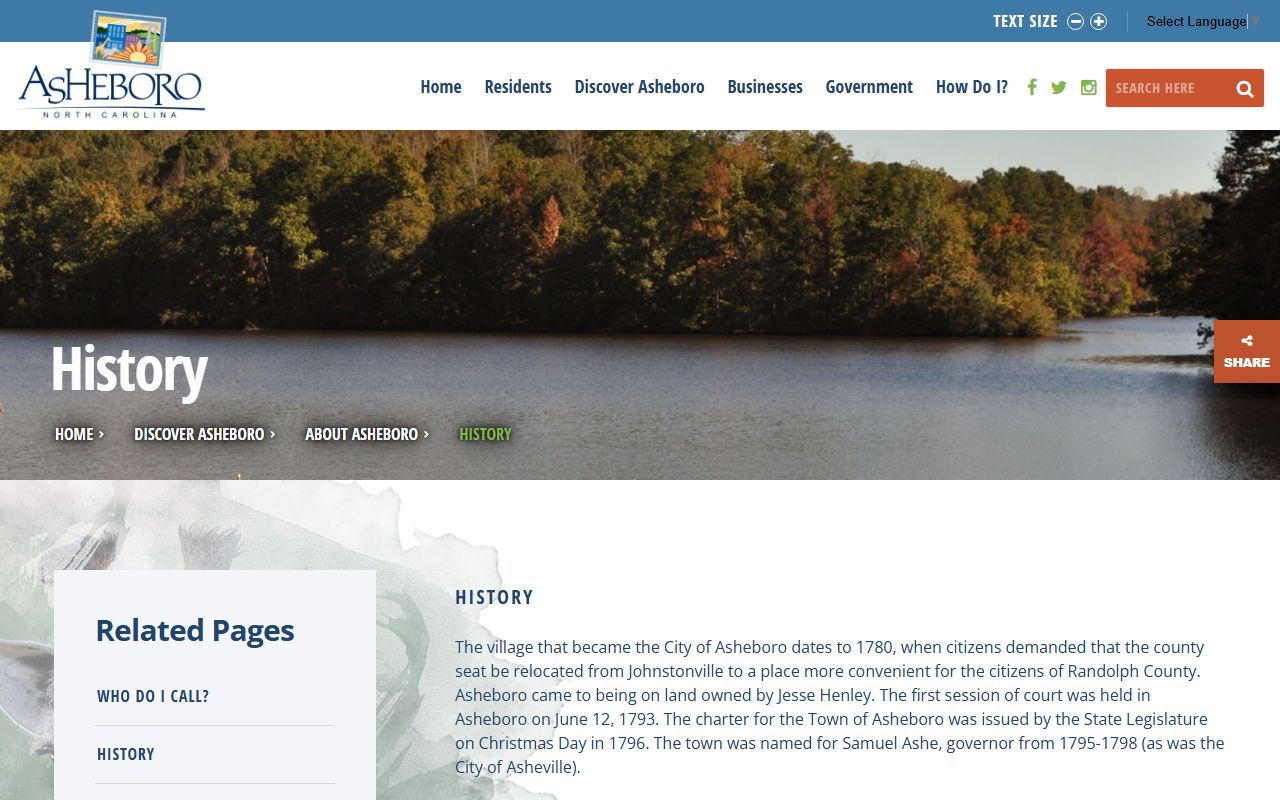
That local history helps explain why court offices and records counters cluster in downtown Asheboro.
Randolph County Local Context
Randolph County is a Piedmont and Triad county with Asheboro as the county seat. U.S. Census QuickFacts lists a July 1, 2025 population estimate of 149,516 and a 2020 land area of about 782 square miles. Communities relevant to records visitors include Asheboro, Archdale, Randleman, Trinity, Ramseur, Liberty, Franklinville, Seagrove, and Staley.
The U.S. Census QuickFacts source appears in the home image manifest.
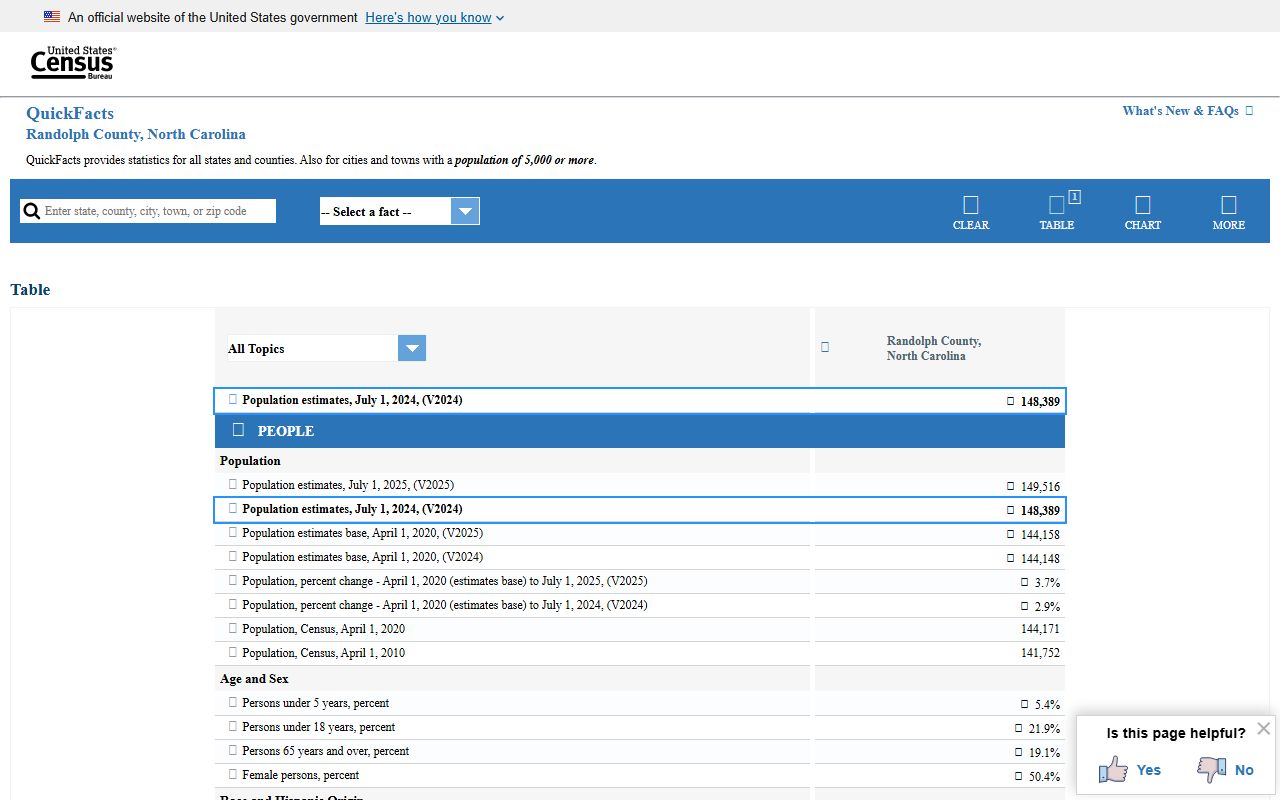
Population and geography help explain why the courthouse, sheriff, and Register of Deeds channels serve a countywide records audience.
The NC government judicial overview is also assigned to the home page.
That state overview reinforces the split between Superior Court, District Court, and appellate review.
Randolph County Court Records FAQ
Can Randolph County court records be searched online? Yes. Public case information, hearing dates, citations, payments, and judgments can be searched through NC eCourts Portal when the record is public. Older, sealed, paper, or certified-copy needs may require the Clerk of Superior Court.
Where are divorce judgments kept? Divorce judgments are court records. They come from the Clerk of Superior Court in the county where the divorce was granted. NC Vital Records also has divorce certificates from 1958 to the present.
Are marriage records court records? No. Randolph County marriage licenses and marriage certificates are handled by the Register of Deeds at 158 Worth Street in Asheboro.
Is there an official Randolph County warrant search? No standalone public active-warrant database was found. Use the Sheriff's Office, Clerk of Superior Court, magistrate contacts, court case records, and the RCSO App channels documented by the county.
Does the inmate roster prove guilt? No. The roster is a current custody and booking tool. It may show booking or bail information, but it does not prove court status, criminal history, or conviction.
Can a phone be brought into the courthouse? Randolph County says no cell phones, computers, multimedia devices, or cameras are allowed in the courthouse.
Public Record Search
Sponsored Results