
Randolph County Probate Records Overview
North Carolina probate is handled by the Clerk of Superior Court. The NC Judicial Branch estates page states that the elected Clerk of Superior Court in each county acts as probate judge. In Randolph County, that means probate matters are handled by the Randolph County Clerk of Superior Court at the Randolph County Courthouse. Elected clerks and assistant clerks hold most estate hearings and preside over most estate cases. This role is why the local probate office is the clerk's office, even though the record type is not a standard civil lawsuit.
Randolph County probate records may include probate of wills, letters testamentary, letters of administration, estate applications, inventories, annual or final accountings, creditor notices, distribution orders, small-estate affidavits where eligible, guardianship files, and special proceedings. A person searching for estate records should separate probate case information from related property or vital records. Deeds and death certificates may be held by other offices, while the estate file belongs with the court clerk where the case is located.
The NC Judicial Branch estate source explains probate before the clerk and the basic estate administration path.
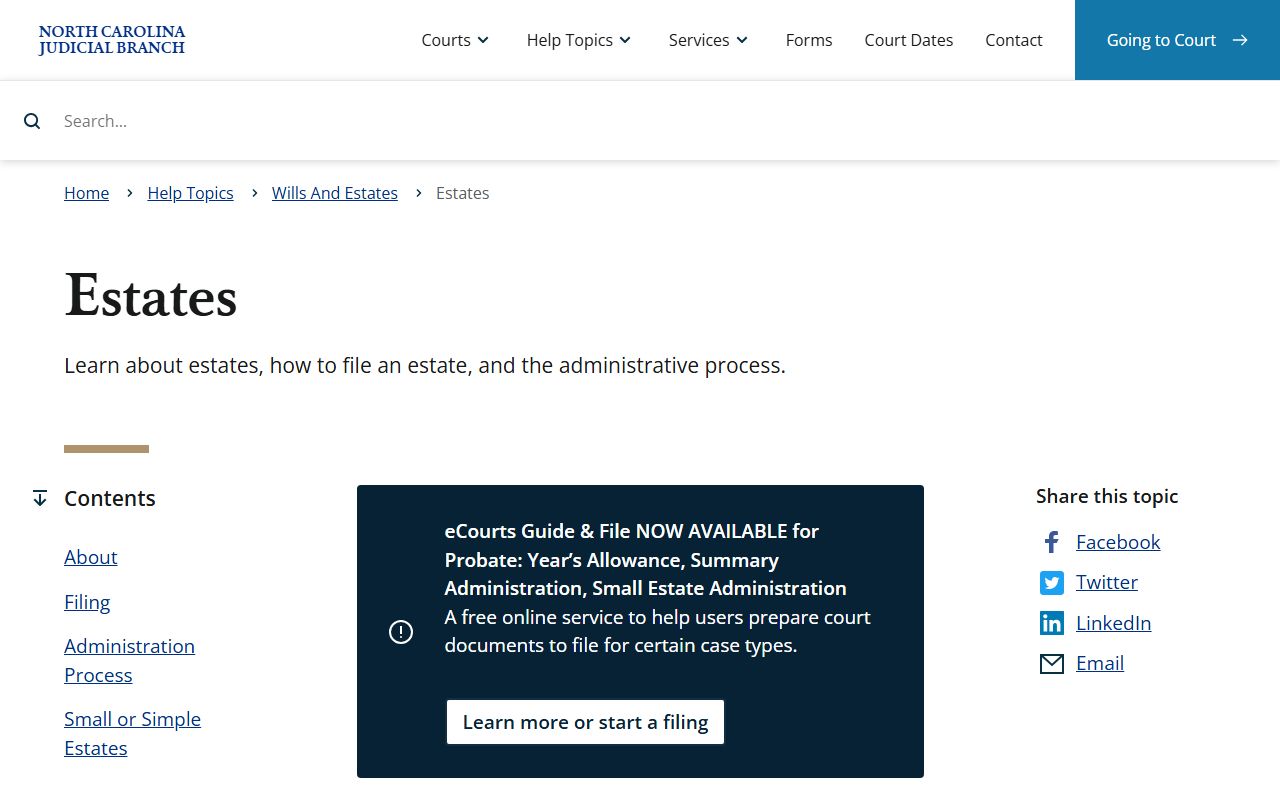
That state source is important for Randolph County because probate authority comes from the statewide Clerk of Superior Court structure.
Randolph County Probate Terms
Probate records use terms that do not always appear in ordinary court dockets. The definitions below keep Randolph County estate files easier to read when the online case summary, clerk file, or letters refer to roles and case events. Some terms describe a person, while others describe the kind of authority or proceeding created by the clerk.
- Testator
- A person who made a will before death.
- Executor
- A person named in a will to carry out estate duties after appointment.
- Intestate
- A death without a valid will, so estate distribution follows state law.
- Letters testamentary
- Clerk-issued authority for an executor to act for the estate.
- Guardianship
- A special proceeding involving legal authority to act for a protected person.
- Conservatorship
- A protective arrangement for managing property or financial interests when state law allows it.
Search Randolph County Probate Records
Estate records may be searched through NC eCourts Portal Smart Search under Estates or Special Proceedings when public information is available online. The Portal can be searched by case number, decedent name, party name, attorney, business name, and cross-reference details. Public access is free, but restricted documents, confidential proceedings, and some protected identifiers are not available to anonymous public users. If the online record is incomplete, public self-service terminals and paper estate files at the clerk's office are the fallback.
- Open Smart Search in the NC eCourts Portal and enter the estate case number or decedent name if known.
- Use location filters to narrow the search to Randolph County.
- Filter by Estates or Special Proceedings when the portal provides a case-type option.
- Review the case summary, filing date, parties, case events, hearings, and any public documents.
- Visit or contact the Randolph County Clerk of Superior Court if the estate file is paper-only, restricted online, or needed as a copy.
| Field Label | Type | Required | Options or Format Notes |
|---|---|---|---|
| Smart Search box | Text | Optional | Case number, party or decedent name, attorney, business, or cross-reference. |
| Location | Filter | Optional | Select Randolph County for local estate records. |
| Case type | Dropdown or filter | Optional | Estates or nonconfidential Special Proceedings. |
| Filing date range | Date range | Optional | Useful for older estates or common names. |
| Case status | Filter | Optional | Status values are not listed publicly by the official page. |
| Party name | Text | Optional | Decedent, petitioner, personal representative, or interested party. |
Randolph County Probate Court Contact
Randolph County does not have a separate county probate court. The probate court function is the Clerk of Superior Court acting as ex officio judge of probate. The courthouse page lists the main courthouse address, the Clerk of Superior Court office suite, public hours, and the clerk phone number. Court visitors should also note Randolph County's courthouse device restriction: no cell phones, computers, multimedia devices, or cameras are allowed in the courthouse.
Clerk of Superior Court acting as ex officio judge of probate
Randolph County Courthouse, Suite 201
176 East Salisbury Street
Asheboro, NC 27203
(336) 328-3100
Clerk's office hours: 8:30 a.m. to 5:00 p.m. weekdays
Randolph County Probate Filing Steps
Probate usually starts in the county where the decedent was domiciled. A Randolph County estate should begin with the Clerk of Superior Court if the decedent lived in Randolph County or if state law otherwise places the estate there. The applicant should bring the original will if one exists, death certificate information, personal identification, and estate details. Statewide North Carolina estate forms should be used, and the Randolph County local rules and forms page routes users to state forms rather than creating a separate local probate packet.
- Determine whether Randolph County is the proper county for the estate.
- Contact or visit the Clerk of Superior Court before filing if the estate type is uncertain.
- Bring the original will, death information, applicant identification, and known estate details.
- Use NC Judicial Branch estate forms and ask the clerk about filing requirements.
- Wait for clerk or assistant clerk review and any letters authorizing a personal representative.
- Give notices, gather assets, handle claims, file inventories and accountings, then request closing or distribution orders as required.
Note: Copies are provided by the clerk for a fee, but exact Randolph estate copy fee amounts were not located in the official local source.
Randolph County Probate Fees
The assigned Randolph County research confirms that probate copies and filings are handled by the Clerk of Superior Court, but it does not publish a local estate fee schedule with exact amounts for probate applications, letters, guardianship filings, or certified estate copies. The fee table therefore identifies the probate cost points a filer should ask about before arriving or mailing materials. It avoids using statewide or third-party figures that were not captured in the official local research.
| Probate Item | Amount | Use |
|---|---|---|
| Estate or probate application filing | Confirm with clerk | Opening an estate, probate of will, or related estate administration matter. |
| Letters testamentary or administration copies | Confirm with clerk | Proof of authority for the personal representative after appointment. |
| Certified copy of estate order or filing | Confirm with clerk | Certified probate documents for banks, title issues, agencies, or court use. |
| Guardianship or special proceeding filing | Confirm with clerk | Protected-person or special proceeding matters that may have restricted access. |
| Portal search | No public-use fee identified | Public Smart Search access is described as free, subject to access limits. |
What Randolph County Probate Records Show
A Randolph County probate search result may show a case number, decedent or estate name, filing date, case type, personal representative, petitioner, attorney information when public, hearings, letters, inventories, accountings, orders, and financial information where available. Portal case summaries can provide a useful index, but the paper file at the clerk's office may remain important for older estates, original documents, copies, or filings not viewable online.
| Probate Field | What It Shows |
|---|---|
| Case number | North Carolina case identifier tied to the estate or special proceeding. |
| Decedent or estate name | The person whose estate is being administered or the estate caption. |
| Filing date | When the estate or special proceeding opened. |
| Representative or petitioner | Executor, administrator, petitioner, or other interested party when public. |
| Case events | Letters, notices, inventories, accountings, hearings, and orders. |
| Caveat indicator | A will-validity challenge that may move before a Superior Court judge. |
Restricted Randolph County Probate Records
Many estate filings are public, but probate-adjacent matters can include restrictions. Guardianships and other special proceedings may involve minors, protected adults, medical details, financial account information, or sealed documents. Portal guidance states that confidential information and protected personal identifiers are not available to public users, and elevated access is reserved for users with statutory authority. Mental health proceedings and adoption-related records should not be treated as ordinary public probate files.
A will contest has its own important caveat rule. If the validity of a will is challenged in a caveat proceeding, the matter is heard by a Superior Court judge rather than handled to completion only by the clerk. That does not mean every estate becomes a Superior Court trial. It means the disputed will-validity issue crosses into the Superior Court process when a proper caveat is filed.
The NC Department of Adult Correction public records page appears in the assigned image set, but it is not a Randolph County probate filing source.
Its inclusion is best read as a reminder that North Carolina records are routed by agency, so estate files belong with the court clerk rather than a correctional public-record channel.