
Randolph County Arrest Records and Court Charges
Randolph County arrest records are created on the law enforcement side of a criminal event. The Randolph County Sheriff's Office, led by Sheriff Gregory J. Seabolt, keeps detention and booking information through the jail and sheriff records channels. Those records can show custody status, booking information, charges connected with the booking event, and bond or bail details when available. They do not prove guilt, and they do not show the full court outcome. For current custody, use the county jail roster and jail phone rather than treating a booking line as a complete criminal history.
Court charges after arrest are tracked through North Carolina court records. Randolph County uses the statewide North Carolina eCourts Portal for public online case lookup. The Randolph County Judicial Branch page also points users to state court resources for court dates, payments, and local court services. Once a criminal case opens, the charge record may show an offense description, case number, process type, bond condition, court event, disposition, and sentence if the case reaches that stage. The full criminal case file belongs with Randolph County criminal court records, while the custody snapshot belongs with Randolph County inmate records.
Charge records are read best as a timeline. The arrest may be followed by a magistrate review, first appearance, District Attorney review, amendment, reduction, dismissal, indictment, plea, or trial. A single arrest can produce more than one charge. A single charge can change status more than once before the court reaches a final result.
Search Randolph County Arrest Records and Charges
Start with the public court file when the question is about filed charges. The NC Judicial Branch Portal training page describes Smart Search as the main case-search tool for public case summaries, also called registers of actions. Smart Search can use a party name, record number, citation number, attorney information, business name, cross-reference number, or nickname. For Randolph County, choose the local court location or use filters that narrow results to the county. The case number format used by Enterprise Justice has a two-digit year, case-type letters, a six-digit sequence number, and a three-digit county identifier, such as 21CR000003-910.
- Open the NC eCourts Portal and use Smart Search for the defendant name, case number, citation number, or other known identifier.
- Filter the location to Randolph County when the search returns statewide matches or common names.
- Open the case summary and read the charge list, case events, hearings, dispositions, and financial entries that are public.
- Use the Clerk of Superior Court if the Portal record is incomplete, restricted, older, or needed as a certified copy.
If the question is about current jail custody, use the sheriff's confined inmate tools instead. The county roster is a booking record and can change quickly. If the question is about a statewide criminal background check, the NC Judicial Branch says background checks should be done through the county clerk's office, not just through the Portal.
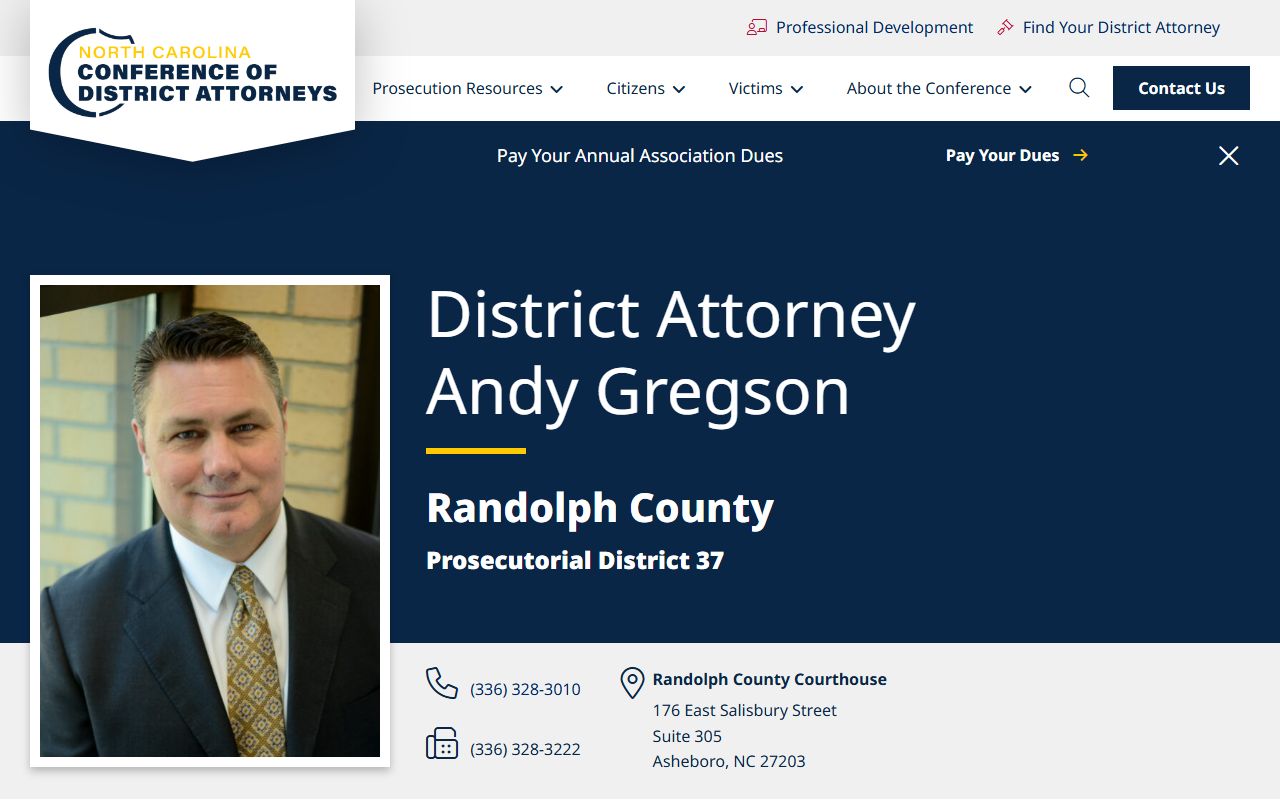
The official District Attorney page for Prosecutorial District 37 identifies the district as covering all of Randolph County and explains the prosecutor's role in criminal cases. The image below comes from that District Attorney source.
Randolph County Charging Documents
A charging document is the paper or electronic filing that states the accusation. In North Carolina criminal practice, charges may appear through a warrant for arrest, criminal summons, citation, magistrate order, indictment, information, or other process depending on the offense and stage of the case. The research source groups criminal court records as including warrants or criminal summons, arrest-related charging instruments, indictments, informations, court dates, bond, pleas, dispositions, sentencing, probation, fines, costs, and case events.
| Charging Document | Common Use | What to Check |
|---|---|---|
| Complaint | Early accusation or magistrate-linked process after arrest or citation. | Offense, defendant, issuing official, date, bond, and first appearance. |
| Information | Prosecutor-filed charging document when that procedure is used. | Filed offense, case number, prosecutor action, and later amendment history. |
| Indictment | Grand jury felony charging document, sometimes sealed before arrest. | Count, offense language, file number, return date, and later amendments. |
North Carolina public-record law treats returned arrest warrants, returned search warrants, indictments, criminal summons, and nontestimonial identification orders as public unless sealed. That does not mean every pending investigative document is open. It means the public status often turns on whether the process has been returned, placed in the court file, or sealed by court order.
Randolph County Charge Status
Charge status is the current procedural state of an accusation. A charge may be pending at first appearance, amended after prosecutor review, reduced as part of a plea, dismissed before trial, or resolved by conviction. The same case can have several charges with different outcomes. Read each charge line separately instead of assuming one final result applies to the whole case.
| Status | Meaning in a Charge Record | Reader Caution |
|---|---|---|
| Pending | The accusation has not reached final disposition. | Check the next hearing and bond terms. |
| Amended or reduced | The filed charge changed by prosecutor action, plea terms, or court order. | Compare the original charge with the current charge. |
| Dismissed | The charge ended without a conviction on that count. | A different charge in the same case may still remain. |
| Disposition entered | The court recorded an outcome such as plea, verdict, dismissal, or judgment. | Review sentence, costs, probation, or appeal events. |
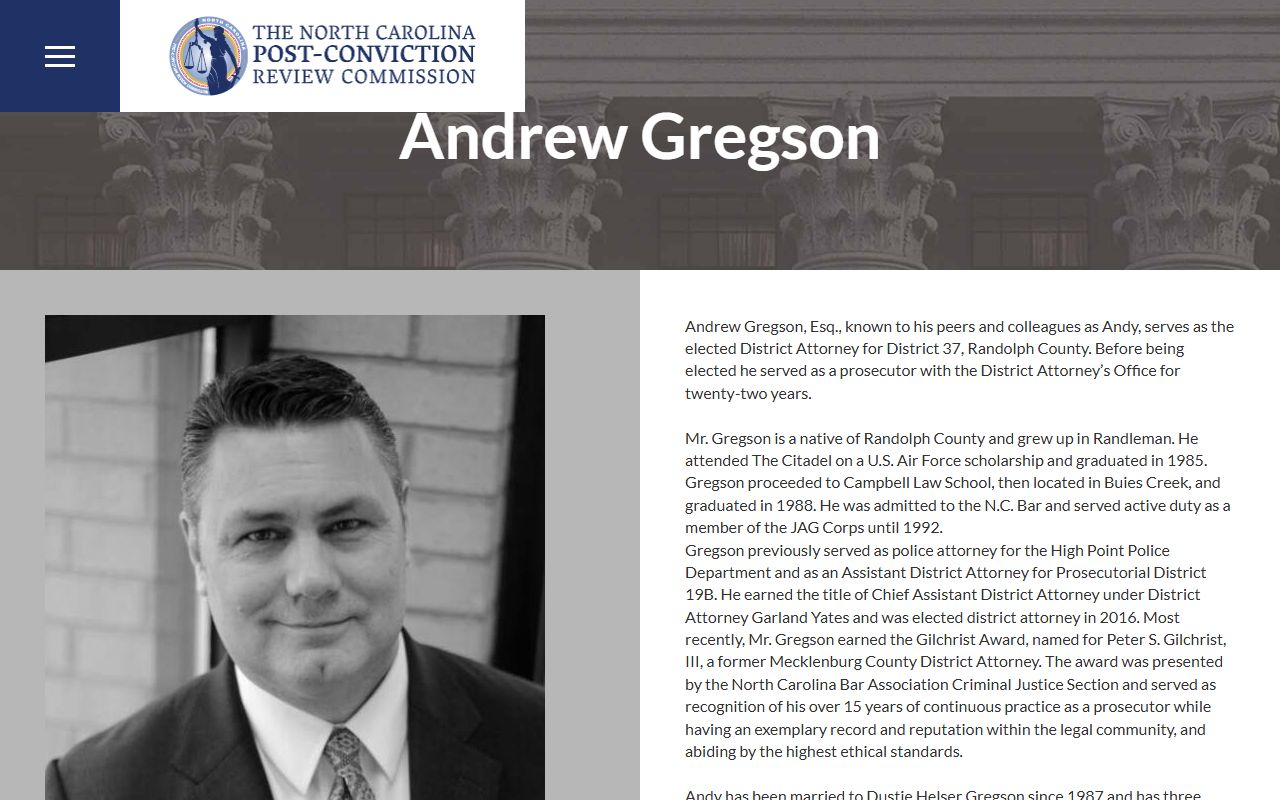
The NC Innocence Inquiry Commission biography for Andrew "Andy" Gregson identifies him as the elected District Attorney for District 37 after years as a prosecutor. That source adds useful context for Randolph County criminal prosecution.
Randolph County Charges vs Convictions
A charge is an accusation. A conviction is a court result based on a guilty plea, verdict, or other adjudication that counts as guilt. The distinction is central to Randolph County arrest records because an arrest can appear before the court decides anything. Booking data, bond data, and an open charge should not be described as a conviction.
| Point | Charge | Conviction |
|---|---|---|
| Stage | Filed accusation after arrest, citation, summons, or indictment. | Final or qualifying court outcome on a charge. |
| Proof level | Based on probable cause or formal charging authority. | Based on plea, verdict, or legal adjudication. |
| Public record use | Useful for case tracking and court dates. | Used to understand judgment, sentence, and record consequences. |
| What to verify | Case events, next hearing, bond, and amendments. | Disposition, sentence, probation, fines, costs, and appeal status. |
When a Randolph County case includes several counts, one count may be dismissed while another leads to a plea. Read the disposition field for each charge. If the public Portal does not show enough detail, the Clerk of Superior Court at the Randolph County Courthouse can direct record users to the public terminal or paper file process.
Public Access to Randolph County Charge Records
Randolph County court charge records are part of the North Carolina state court system, not a county-owned court database. The NC Judicial Branch court-record guidance says criminal cases can be accessed from public self-service terminals in a clerk of court office. Searches may be made by defendant name, case number, or victim or witness name. Paper files are viewed in the county where the case is located, and copies may be made for a fee set by the court system.
North Carolina public access is broad, but it has limits. The N.C. Gen. Stat. Chapter 132 index gives the general public-record framework. Portal guidance also notes that restricted case types, confidential data, protected identifiers, and non-public documents are not available to anonymous public users. Elevated access is only for people with statutory authority.
For defense access, the NC Indigent Defense Services Randolph County page identifies Randolph County in the public defense system.
Restricted Randolph County Arrest Records
Some arrest and charge records are restricted by law, sealed by court order, or removed from public access after expunction. Juvenile court records are not ordinary public case files. Mental health matters and protected personal identifiers are also limited. A pending investigation can create more limits than a returned process in a court file. Do not assume that an absent public result means no event occurred.
Expunction is the North Carolina process that can clear eligible public records of an arrest, charge, or conviction. N.C. Gen. Stat. 15A-145.5 covers some nonviolent misdemeanors and felonies, but it has exclusions, including impaired driving and other disqualifying offenses. N.C. Gen. Stat. 15A-153 describes the effect of an expunction as clearing public records of an expunged arrest, charge, or conviction. Eligibility depends on the offense, result, prior record, waiting period, and statutory limits.
The NC IDS public defense overview explains North Carolina's appointed counsel system through defender offices, contracts, and appointed private counsel.
Note: A dismissed charge may be eligible for relief, but dismissal alone does not automatically remove every public record.
Randolph County Charge Record Contacts
Use the office that matches the question. The court clerk handles court files, copies, and public terminals. The sheriff handles booking and jail-status questions. The District Attorney prosecutes criminal cases for the State and prepares the criminal trial docket, but the DA's office is not a public background-check office. For current bond or custody, call the jail. For case records, call the clerk.
Clerk of Superior Court
176 East Salisbury Street, Suite 201
Asheboro, NC 27203
(336) 328-3100
Office hours: 8:30 a.m. to 5:00 p.m. weekdays
Randolph County Sheriff's Office
727 McDowell Road
Asheboro, NC 27205
Records: (336) 318-6698
Non-emergency: (336) 318-6699