
Randolph County Criminal Court Records
A Randolph County criminal court record is the court case file kept by the Clerk of Superior Court after a charge is filed or carried into court. It is broader than a booking entry. The case record may show the charging document, defendant information, case number, bond entries, hearing history, motions, pleas, dispositions, sentence terms, financial obligations, and probation or parole fees when those details are part of the public file.
Superior Court and District Court divide criminal work in North Carolina. Superior Court is the general jurisdiction trial division for felonies and appeals from District Court misdemeanor and infraction matters. District Court handles misdemeanors, infractions, criminal traffic matters, first appearances within its authority, and many lower-level criminal settings. Magistrates may be involved at the start of a case through warrants, criminal process, bond-related functions, and first appearance or release issues within statutory authority.
A charge-level explanation fits better on the Randolph County arrest records and court charges page, while this criminal court records page stays focused on the full case file and its outcome.
Search Randolph County Criminal Cases
The main public search point is the North Carolina eCourts Portal. Smart Search can locate criminal actions by defendant name, case number, citation number, attorney name, attorney bar number, business name, cross-reference number, or nickname. Advanced filters can narrow by location, case type, case status, filing date range, and party criteria. Choose Randolph County when the search should be local to the courthouse in Asheboro.
NC Judicial Branch states that criminal cases can also be accessed through public self-service terminals in a clerk of court office. Searches can be made by defendant name, case number, or victim or witness name. Paper files are viewed through the clerk's office in the county where the case is located. For criminal background-check use, the Judicial Branch guidance says to use the county clerk's office rather than treating Portal as the background-check source.
- Open Portal and use Smart Search for criminal case information.
- Search by defendant name, exact case number, citation number, attorney information, or cross-reference number.
- Filter by Randolph County and criminal actions when the results are too broad.
- Open the case summary to review hearings, events, dispositions, financial entries, and public document links.
- Use the Clerk of Superior Court for certified copies, paper files, terminal searches, or background-check requests.
Randolph County Criminal Case Flow
A criminal case record grows as the case moves through court. Early entries may show the charge, warrant, summons, bond, or first appearance. Later entries may show arraignment, motions, continuances, plea settings, trial events, verdicts, dispositions, sentence terms, financial obligations, and probation conditions. A single case can include charges that are amended, reduced, dismissed, or resolved in different ways.
Case flow: Charges Filed › Arraignment › Pretrial and Motions › Plea or Trial › Disposition › Sentencing
| Stage | What Happens |
|---|---|
| Charges filed | The case begins from a criminal charge, warrant, summons, citation, information, or indictment, depending on the matter. |
| Arraignment | The court addresses the charge and plea posture. Felony cases may move differently than misdemeanor cases. |
| Pretrial and motions | The docket may show continuances, motions, discovery-related events, bond issues, or orders. |
| Plea or trial | The record may show a guilty plea, not guilty plea, trial setting, verdict, or dismissal. |
| Disposition | The case or charge receives an outcome, such as guilty, not guilty, dismissed, or another court-recognized result. |
| Sentencing | After conviction, the case may show punishment, probation, costs, fines, restitution, and related financial entries. |
Randolph County Criminal Record Fields
Criminal court records in Randolph County should be read field by field. The case number identifies the file. The event history shows how the case moved. The disposition shows the outcome, but it must be matched to the right charge. Financial entries may include court costs, fines, restitution, attorney fees, or probation-related amounts. Some public results will not show document images or protected personal details.
| Field | What It Shows |
|---|---|
| Case number | The Enterprise Justice identifier, such as a two-digit year, CR case type, six-digit sequence, and county identifier. |
| Defendant | The person charged, subject to public visibility and redaction rules. |
| Charge or offense | The offense description, charge class, citation or process link, and related charge-level details when public. |
| Bond and first appearance | Release terms, bond-related entries, magistrate involvement, and first appearance details when recorded. |
| Hearings | Dates, times, courtroom, event type, and judicial officer where public. |
| Plea | The defendant's answer to a criminal charge, such as guilty or not guilty, when entered. |
| Disposition | The outcome of the charge or case, which must be read separately from the original accusation. |
| Sentence | Punishment or conditions after conviction, including probation, fines, costs, restitution, or other court terms. |
| Documents | Public document links when available, with restricted documents hidden or limited to elevated access. |
Randolph County Criminal Prosecution
The District Attorney for Prosecutorial District 37 is Andy Gregson. The official District Attorney page says District 37 encompasses all of Randolph County. The District Attorney represents the State in criminal proceedings against people accused of crimes, protects victims and their rights, prosecutes criminal cases in District and Superior Courts, prepares the criminal trial docket, represents the State in juvenile proceedings, and advises law enforcement officers.
Randolph County is also listed through the North Carolina Indigent Defense Services system. The assigned research did not locate a separate Randolph County public defender office address. North Carolina public defense may be delivered through public defender offices, contract attorneys, or judicial appointment of private assigned counsel. For that reason, copy should refer to appointed counsel or IDS rather than naming a local public defender office that was not found in official sources.
| Office | Role in Criminal Court Records | Contact |
|---|---|---|
| District Attorney, Prosecutorial District 37 | Prosecutes criminal cases, prepares criminal trial dockets, and represents the State. | (336) 328-3010 |
| Clerk of Superior Court | Keeps criminal case records, filings, costs, copies, and public terminal access. | (336) 328-3100 |
| NC Indigent Defense Services | Supports appointed counsel systems for eligible defendants. | (919) 354-7200 |
Charges vs Convictions
A Randolph County criminal court record can show an accusation that never became a conviction. A charge means the State alleged an offense and brought it into the court process. A conviction means guilt was entered by plea or found by the court after the required process. Dismissed charges, reduced charges, amended charges, and not guilty outcomes should not be described as convictions.
| Point | Charge | Conviction |
|---|---|---|
| Meaning | An allegation filed in the court system. | A guilty plea, guilty finding, or verdict entered by the court. |
| Where it appears | Charging document, warrant, summons, citation, indictment, or case summary. | Disposition, judgment, sentence, and related financial entries. |
| Can change | May be amended, reduced, dismissed, or superseded. | May later be affected by appeal, post-conviction order, or expunction if eligible. |
| How to read it | Match each charge to its own disposition. | Confirm the final outcome and sentence tied to that charge. |
Access to Randolph County Criminal Records
North Carolina law and court rules control public access to Randolph County criminal court records. N.C. Gen. Stat. Chapter 132 provides the broad public-record framework. The Chapter 132 text also states that returned arrest warrants, returned search warrants, indictments, criminal summons, and nontestimonial identification orders are public records unless sealed by court order. Portal guidance also refers to public inspection duties under N.C. Gen. Stat. 7A-109(b).
The NC SBI background check page points users toward court records and public safety information for background-check needs.
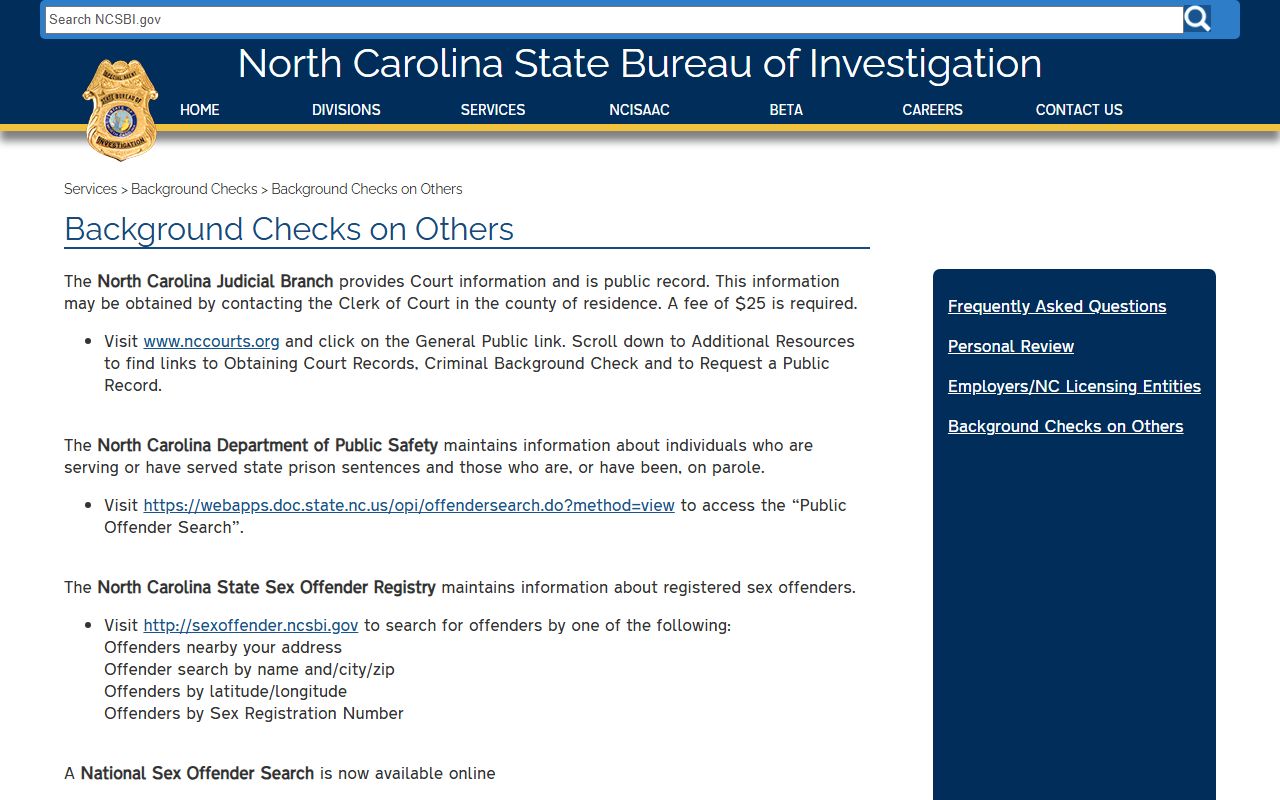
That background-check source reinforces a key Randolph County point: casual Portal lookup and formal criminal-history use are not the same task.
Note: NC Judicial Branch guidance says criminal background checks should be handled through the clerk's office rather than Portal alone.
Sealed vs Expunged Records
Sealed and expunged records have different effects. A sealed Randolph County criminal court record is withheld from public access by law or court order, but it may still exist for limited authorized purposes. An expunged record is handled under a statutory process that may clear public records of an eligible arrest, charge, or conviction. Eligibility depends on the offense, disposition, prior record, waiting period, and statutory exclusions.
The N.C. Gen. Stat. 15A-145.5 expunction statute covers some nonviolent misdemeanors and felonies, with exclusions such as impaired driving. N.C. Gen. Stat. 15A-153 describes the effect of expunction and the goal of clearing public records of expunged arrests, charges, or convictions.
The manifest assigned the N.C. Gen. Stat. 15A-153 source to this Randolph County criminal court records page.
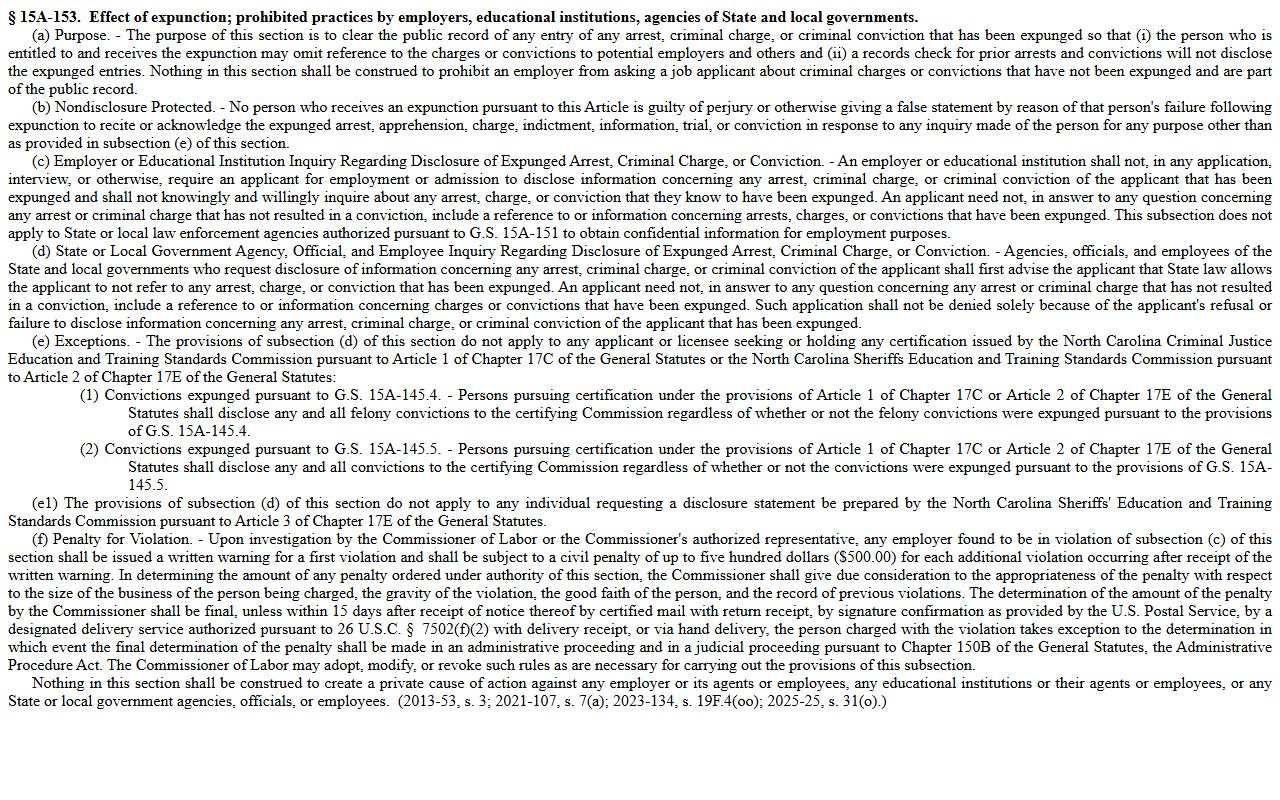
That statute is the reason an expunged Randolph County criminal record should not be treated like a normal public case record.
| Point | Sealed | Expunged |
|---|---|---|
| Public visibility | Hidden from ordinary public access by law or order. | Cleared from public records if the expunction is granted. |
| Record status | The record still exists but is not public. | The public record is treated under the expunction statute's effect. |
| Eligibility | Depends on the case type, order, and governing law. | Depends on a specific expunction statute and case facts. |
| Search result | Portal or clerk public access may not show the record. | A public records check should not disclose the expunged entry as a normal public record. |
Restricted Randolph County Criminal Records
Not every criminal-related record is public. Juvenile delinquency, abuse, neglect, and dependency records are not ordinary public case records. NC DPS says juvenile record requests must be submitted in writing through the Juvenile Justice and Delinquency Prevention records officer and records request process. Mental health-related matters, protected personal identifiers, sealed documents, and confidential case details are also restricted from public Portal access.
The NC DPS juvenile records page is the official source for juvenile record request routing.
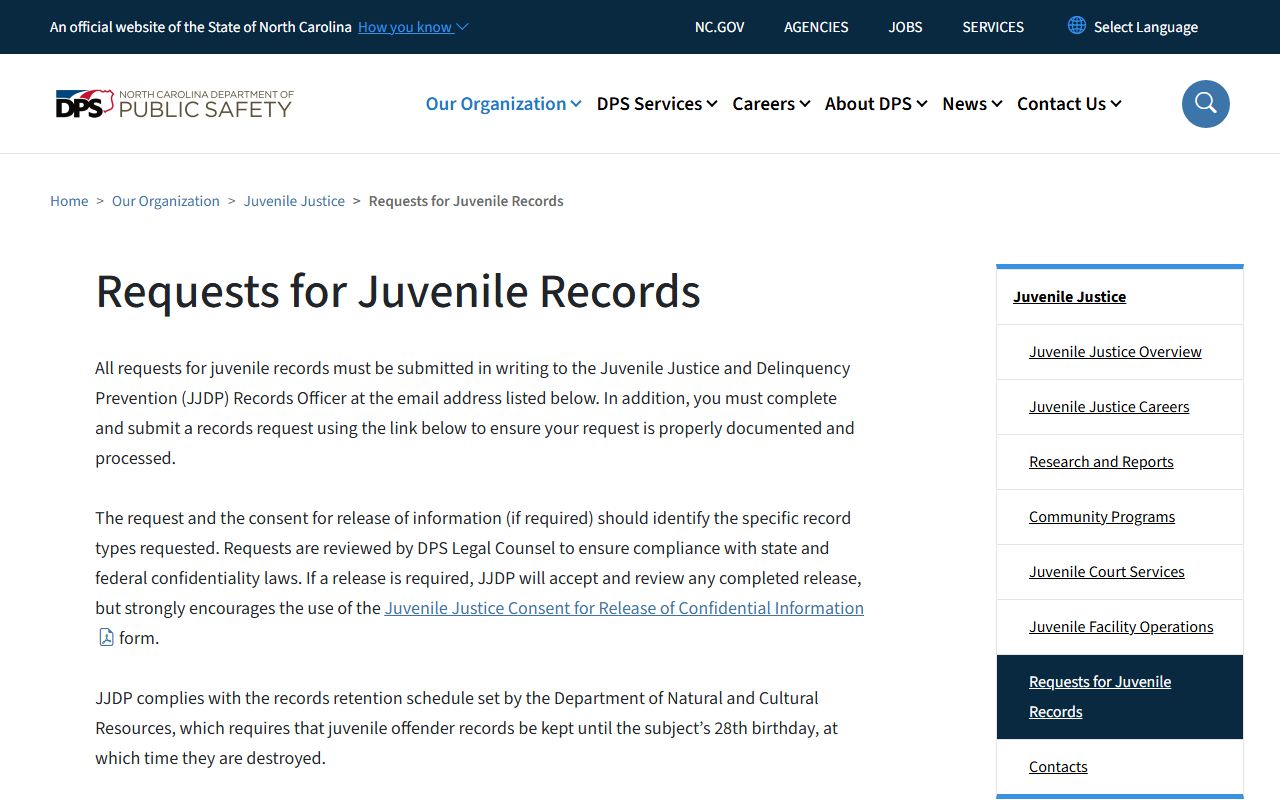
That juvenile-records source supports the Randolph County caveat that juvenile court records should not be searched or described like routine adult criminal case files.
Randolph County Criminal Record Requests
The Clerk of Superior Court is the local office for criminal case files, public terminals, paper records, copies, costs, and certified-copy needs. The clerk is located at the Randolph County Courthouse in Asheboro. The courthouse is a state court location, and Randolph County's own courthouse page points residents to the North Carolina Court System for court calendars, fines, payments, and telephone directory information.
Visitors should account for the courthouse device rule. Randolph County says no cell phones, computers, multimedia devices, or cameras are allowed in the courthouse. That affects anyone visiting the clerk's office to inspect a file, use a terminal, or attend a criminal hearing. ADA assistance begins at the Bailiff's Information Desk at (336) 318-6474, with the Clerk of Superior Court ADA Coordinator listed at (336) 328-3100.
Clerk of Superior Court
Randolph County Courthouse, Suite 201
176 East Salisbury Street
Asheboro, NC 27203
(336) 328-3100
8:30 a.m. to 5:00 p.m., Monday through Friday
Public Record Search
Sponsored Results